
Magnet Design & Electromagnetic Systems Engineering
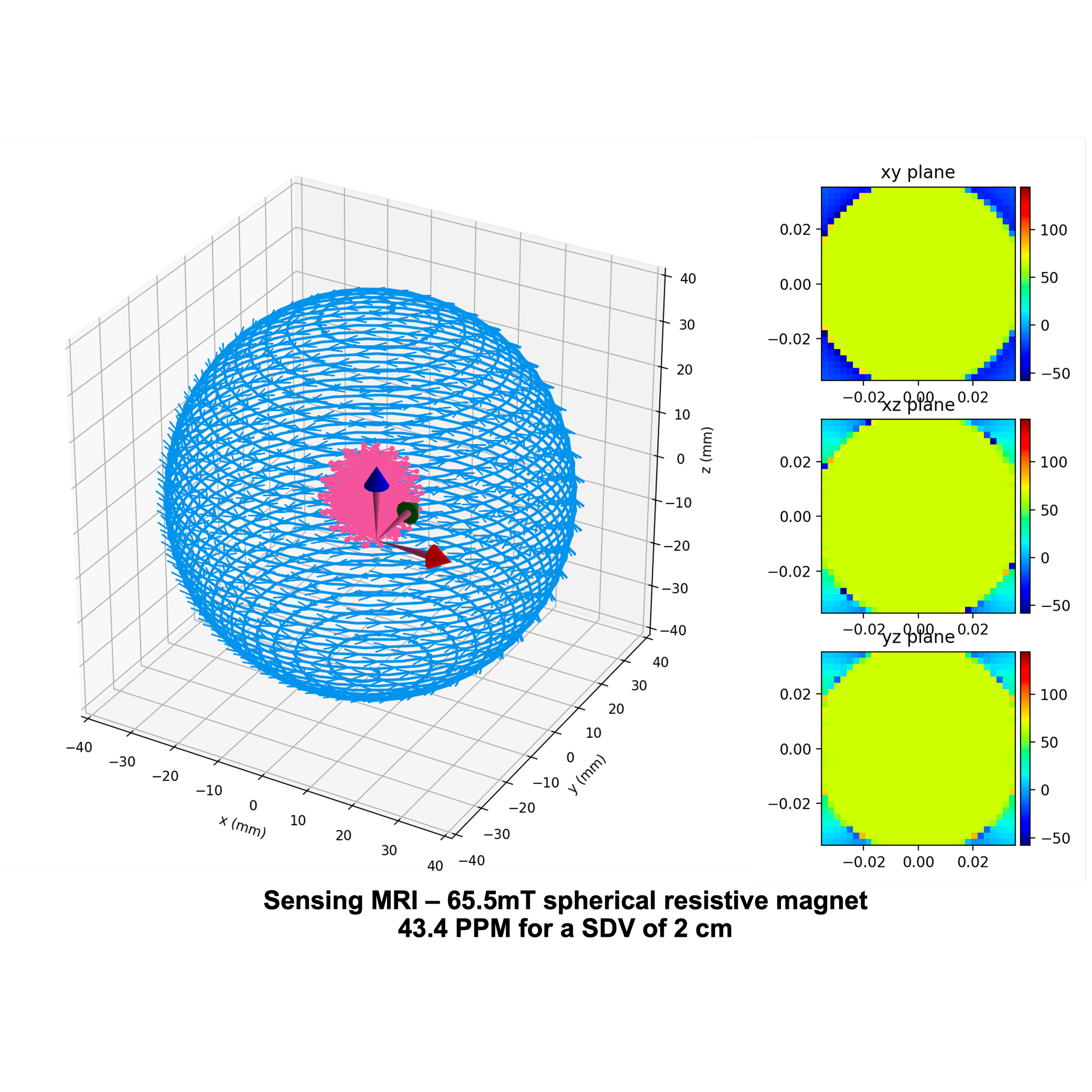
We provide advanced magnet design and electromagnetic systems engineering services for permanent and resistive magnet architectures used in MRI systems, electric motors, and magnetic sensor platforms.
Our work spans the full engineering lifecycle—from requirements definition and first-principles modeling to hardware realization and experimental validation—enabling rapid development of high-performance, application-specific magnetic systems
The Process
01
Projects begin with a detailed requirements and constraints analysis, translating field homogeneity, strength, stability, efficiency, thermal limits, and mechanical tolerances into quantitative design targets.
02
We then perform in-silico design and optimization using high-fidelity electromagnetic and multiphysics simulations, including magnetostatic, transient, thermal, and structural analyses. These simulations are used to optimize magnetic field quality, force and torque profiles, losses, and sensitivity to manufacturing tolerances and environmental variations.
03
In parallel with magnet development, we design and validate the electronic systems required to drive, control, and measure magnetic performance. This includes current sources and power electronics for resistive magnets, sensor and readout electronics, control and feedback loops, and signal-conditioning hardware developed specifically around the magnetic architecture. Electronics design is informed by the electromagnetic model to minimize noise, coupling, drift, and interference, particularly in precision applications such as MRI and sensing.
04
We support the transition from design to fabrication, advising on material selection, winding strategies, magnetization processes, mechanical integration, and thermal management. Designs are developed with manufacturability and testability in mind, enabling efficient prototyping and scalable production.
05
Finally, we conduct or support experimental benchmarking and validation, including magnetic field mapping, stability and drift measurements, efficiency characterization, and electronics performance testing. Measured data are fed back into simulation models to close the design loop, ensuring correlation between predicted and realized performance.
Have a project in mind?
This integrated approach—combining magnetics, electronics, simulation, fabrication support, and experimental testing—allows us to deliver robust, validated magnet systems and associated electronics that meet stringent engineering and system-level requirements.