
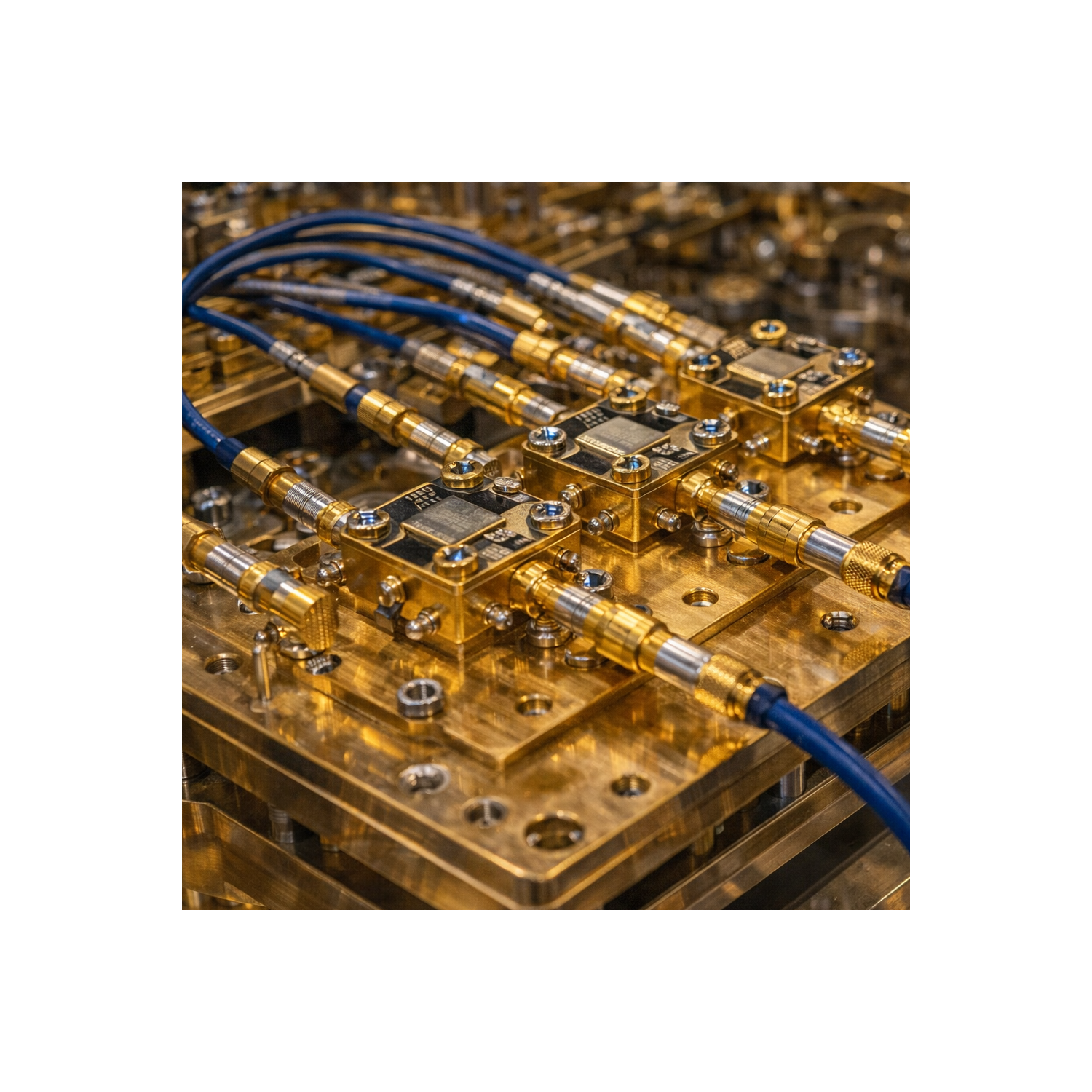
Switching systems for quantum
Microwave switching systems are critical components in scaling quantum computers, particularly those based on superconducting qubits or spin qubits. They function as the "traffic controllers" for the microwave pulses used to manipulate and read out quantum states.
Without these switches, every single qubit would require its own dedicated cable running from room temperature down to the quantum processor at near-absolute zero (millikelvin temperatures). This creates a "wiring bottleneck"—a massive physical and thermal constraint that prevents processors from scaling beyond a few hundred qubits.
Thermal management and the development of specialized RF/microwave-cooled systems
We possess vast knowledge in thermal management and the development of specialized RF/microwave-cooled systems, enabling us to tackle the unique challenges of quantum signal routing. Our engineering design process focuses on developing bespoke cryo-cooled switching architectures that minimize thermal load while maximizing signal fidelity. By integrating these systems directly into the cryogenic environment, we ensure low loss capabilities and maintain superior signal integrity closer to the quantum processor, effectively addressing the interconnect bottleneck.
Custom-designed non-cryo-cooled switches
In addition to cryogenic solutions, we offer custom-designed non-cryo-cooled switches as a robust alternative for room-temperature stages. This capability allows us to tailor the system architecture based on your specific return loss needsand power budgets. Whether your application requires the extreme sensitivity of deep-cryo routing or the flexibility of external switching matrices, we engineer a cohesive solution that optimizes performance across the entire thermal gradient of your quantum setup.
Why Microwave Switching is Necessary
The primary goal of these systems is Multiplexing and Signal Routing.By using switches inside the dilution refrigerator (the cooling system), a single control line can address multiple qubits, drastically reducing the hardware footprint.
Signal Integrity: Long cables introduce noise and loss. Switching signals closer to the chip preserves fidelity.
Scalability: To reach millions of qubits, the ratio of input cables to qubits must drop from 1:1 to 1:100 or 1:1000.
Common Architectures
Time-Division Multiplexing (TDM)
Similar to how cell phone towers work, a single generator sends a pulse train. A fast switch at the bottom of the fridge directs Pulse A to Qubit 1, then Pulse B to Qubit 2.
Requirement: Needs fast switches (Superconducting or CMOS) to switch between pulses without delaying the computation.
Frequency-Division Multiplexing (FDM)
Used primarily for Readout. Multiple resonators are attached to one feedline, each vibrating at a slightly different frequency.
Role of Switching: Switches are used here to select which group of resonators (e.g., which row of the chip) is currently being probed.
Matrix/Crossbar Routing A grid of switches allows any input line to connect to any output line.
Application: This is crucial for Sparse interconnects. If a control line breaks or a qubit dies, the matrix can re-route signals to bypass the bad components, improving chip yield.
Key Challenges
Thermal Budget: The switch itself cannot generate heat. At 10 mK, even a microwatt of heat can crash the quantum computer.
Crosstalk: If a switch leaks even 0.1% of a microwave signal, it can inadvertently flip a neighbor qubit, causing calculation errors.
Latency: The control electronics (often at room temperature) need to tell the switch to open/close. The time it takes for that signal to travel down the wires is a hard limit on speed.

Made in the USA
At Qubit Microwave, we strive for the highest quality products. All designs are fabricated in the USA, enabling streamlined production and competitive pricing without foreign tariffs.