
 Image 1 of 1
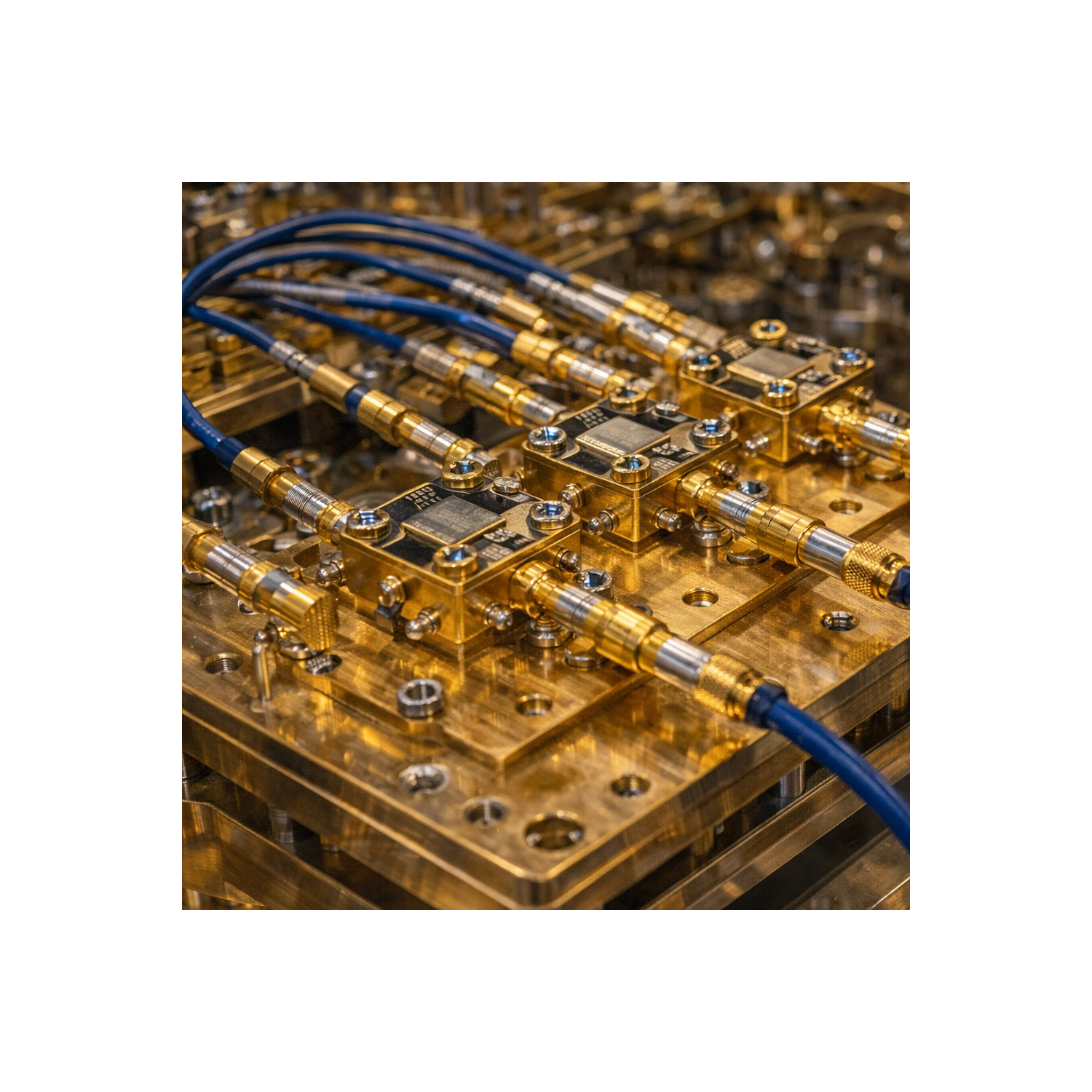
Why Microwave Switching is Necessary
The primary goal of these systems is Multiplexing and Signal Routing.By using switches inside the dilution refrigerator (the cooling system), a single control line can address multiple qubits, drastically reducing the hardware footprint.
Signal Integrity: Long cables introduce noise and loss. Switching signals closer to the chip preserves fidelity.
Scalability: To reach millions of qubits, the ratio of input cables to qubits must drop from 1:1 to 1:100 or 1:1000.
**Common Architectures ** **Time-Division Multiplexing (TDM) **
Similar to how cell phone towers work, a single generator sends a pulse train. A fast switch at the bottom of the fridge directs Pulse A to Qubit 1, then Pulse B to Qubit 2.
Requirement: Needs fast switches (Superconducting or CMOS) to switch between pulses without delaying the computation.
**Frequency-Division Multiplexing (FDM) **
Used primarily for Readout. Multiple resonators are attached to one feedline, each vibrating at a slightly different frequency.
Role of Switching: Switches are used here to select which group of resonators (e.g., which row of the chip) is currently being probed.
Matrix/Crossbar Routing A grid of switches allows any input line to connect to any output line.
Application: This is crucial for Sparse interconnects. If a control line breaks or a qubit dies, the matrix can re-route signals to bypass the bad components, improving chip yield.
Key Challenges
Thermal Budget: The switch itself cannot generate heat. At 10 mK, even a microwatt of heat can crash the quantum computer.
Crosstalk: If a switch leaks even 0.1% of a microwave signal, it can inadvertently flip a neighbor qubit, causing calculation errors.
Latency: The control electronics (often at room temperature) need to tell the switch to open/close. The time it takes for that signal to travel down the wires is a hard limit on speed.